

Hey Parents, welcome in…
Parenting today can feel overwhelming.
You may be noticing changes in your child — increased anxiety, mood shifts, school struggles, social withdrawal, irritability, or behaviors that leave you unsure how to respond. You might be wondering if this is a phase, stress, something deeper, or simply your child trying to cope the best way they know how.
Seeking support for your child is not a sign that you’ve failed. It’s often a sign that you’re paying attention.
In therapy, your child will have a space to process what they’re experiencing, build emotional regulation skills, and develop confidence in navigating their world. At the same time, you won’t be left out of the process. We work collaboratively, balancing your child’s need for privacy with your need to stay informed and supported.
You don’t have to carry this alone. Support can feel steady, thoughtful, and practical — not dramatic or intimidating.

-
Adolescence comes with a lot of change. Hormones shift. Friendships change. Academic pressure increases. Social dynamics get more complex. Sometimes there are big transitions happening too — a move, divorce, loss, bullying, identity exploration, school changes, or friend group conflict.
It can be difficult to tell what is typical developmental growth and what may be anxiety, depression, trauma, or stress that needs additional support.
If you’re noticing increased mood swings, withdrawal, irritability, school avoidance, sleep changes, loss of interest, heightened anxiety, or signs your child may be struggling socially or being treated poorly by peers, it’s okay to trust that instinct. You do not have to wait for things to get worse before seeking support.
Therapy can provide a steady place for your child to process big changes, build coping tools, and feel understood during a season that can feel overwhelming. Even if what they are experiencing turns out to be part of normal development, having support during that time can make a meaningful difference.
-
Jillian
Works with children, teens, and adults ages 2 years and older.
Also offers parent coaching and parent support sessions.
Currently not accepting new clients.
Molly
Works with adolescents and adults ages 11 years and older.
Chloe
Works with children, teens, and young adults ages 2 years and older.
Tiana (Clinical Mental Health Counseling Intern)
Works with children, teens, young adults, and adults ages 3 years and older.
Also provides couples therapy, family therapy, and parent coaching sessions. -
Yes. We offer free 15-minute phone consultations.
This is a chance for you to briefly share what’s bringing you in, ask questions about our approach, and determine whether we may be a good fit for your child or family. There’s no pressure to commit during this call.
You can call or text our office to schedule a consultation, or book directly through our website.
-
The first session is typically an intake appointment. During this time, we spend a lot of time getting to know your child and your family.
We’ll ask questions about current concerns, history, strengths, daily functioning, and what you’re hoping to see improve. This session is also focused on building rapport. We want your child to feel comfortable, not interrogated. Depending on age and needs, part of the session may include time with the parent and part may be one-on-one with your child.
By the end of the intake, we’ll have a clearer picture of what’s going on and begin outlining goals for therapy together.
-
ABSOLUTELY - check out our groups page for more information.
-
Yes. We work with many homeschool families and understand the unique rhythms, flexibility, and pressures that can come with homeschooling. Academic structure, social opportunities, parent involvement, and identity development can look different in homeschool settings, and we approach those differences with curiosity and respect rather than assumptions.
Two of our clinicians are homeschool moms, and the rest of our team is homeschool affirming. We recognize that homeschool families often navigate social development, academic pacing, extracurricular balance, and community building in ways that differ from traditional school settings. Whether your child is thriving, feeling isolated, navigating anxiety, or simply needing a space that is separate from home and academics, therapy can provide a supportive and neutral environment.
We also offer group options that can help homeschool tweens and teens build social confidence and emotional skills in a structured, welcoming setting.
-
Tweens and teens often struggle with traditional “sit and talk” therapy, especially if they feel put on the spot. We integrate creative and developmentally appropriate approaches to make therapy feel engaging, interactive, and meaningful.
This may include sand tray work, art-based interventions, structured skill-building exercises, emotion mapping, role play, visual tools, and other hands-on methods that help clients express themselves without feeling pressured. For some, we incorporate structured cognitive and coping skills; for others, we lean more into creative expression or metaphor-based work.
The goal is not to entertain, but to create a space where your child feels comfortable enough to explore what is going on beneath the surface while also building practical tools they can use in everyday life.
-
Play therapy is a way for children to express their thoughts and feelings using play instead of just words.
Kids don’t always have the language to explain what’s going on inside them, but they do know how to show it through things like toys, art, games, and imagination. In play therapy, those things become their way of “talking.”
How Does It Help?Through play therapy, children can:
Work through big feelings like anxiety, anger, or sadness
Make sense of confusing or stressful experiences
Learn healthy ways to cope and calm their bodies
Build confidence and problem-solving skills
Feel understood, safe, and supported
The therapist follows the child’s lead while gently guiding when needed, helping them process what they’re going through in a way that feels natural and not overwhelming.
The Big PictureTo a child, it might look like they’re “just playing,” but underneath, they’re:
Processing emotions
Practicing new skills
Building resilience
Play is their language, and therapy meets them right there.
References
https://pmc.ncbi.nlm.nih.gov/articles/PMC8812369/
https://www.a4pt.org/page/PTMakesADifference/Play-Therapy-Makes-a-Difference.htm#:~:text=Play%20therapy%20can%20be%20used%20to%20treat,relational%20skills%20with%20family%20*%20Develop%20self%2Defficacy
-
Therapy is most effective when children and teens feel safe to speak openly. To build that trust, sessions are generally confidential. This means we do not share specific details of what your child says unless there is a safety concern. However, you will not be left out of the process. We provide updates on overall themes, progress toward goals, and areas we are working on. If your child expresses thoughts of harming themselves or others, or if there are concerns related to abuse or neglect, you will be informed and involved right away. Our goal is to protect your child’s therapeutic space while ensuring their safety and wellbeing.
-
We believe therapy works best when families feel supported as a team. While your child has a private space to process their experiences, we maintain ongoing collaboration with parents. This may include periodic check-ins, shared goal setting, and discussions about patterns we are noticing or skills that can be reinforced at home. We aim to strike a thoughtful balance between honoring your child’s need for confidentiality and keeping you informed in meaningful and appropriate ways.
-
Yes. Parent-only sessions, parent and child sessions, and full family sessions are all encouraged as part of the therapeutic process. We tailor involvement based on your child’s age, needs, and comfort level.
Parent-only sessions provide space to discuss behavior concerns, school challenges, anxiety, family transitions, communication patterns, and parenting strategies. These meetings allow us to problem-solve together, strengthen consistency at home, and support your child more effectively.
Parent and child sessions can be especially helpful when working on communication, repairing conflict, or practicing new skills together in real time with support.
Family sessions are often recommended when patterns within the household are contributing to stress, misunderstandings, or emotional overwhelm. These sessions create space for everyone to feel heard while building healthier dynamics.
Doing your own work as a parent sends a powerful message to your child that growth is not just something expected of them. It shows that you are also willing to reflect, adjust, and grow. As a parent myself, I strongly encourage parents to seek their own support when possible. Parenting is emotionally demanding, and having space to process and develop tools of your own can positively impact the entire family system.
We also offer a virtual parent support group on Thursday evenings at 7pm. I highly recommend this group for all parents, whether your child is a newborn or 40 years old. The shared support, perspective, and practical tools offered in this space can be incredibly helpful at any stage of parenting.
-
If your child is a minor, yes. Your child’s safety is our highest priority. If we have reason to believe your child is at risk of harming themselves or someone else, we will break confidentiality and involve you immediately. This is outlined in our informed consent paperwork and discussed at the start of services so everyone understands how safety concerns are handled.
Whenever possible, we approach these situations collaboratively. We work with your child to explain why a parent needs to be involved and focus on creating a plan that supports safety, not punishment.
Please note that confidentiality laws differ for adult clients (18 and older). For adult clients, privacy is legally protected unless there is imminent risk of serious harm or other specific legal exceptions. These differences are reviewed during the intake process so expectations are clear from the beginning.

Parent Blog

Cheat Sheets
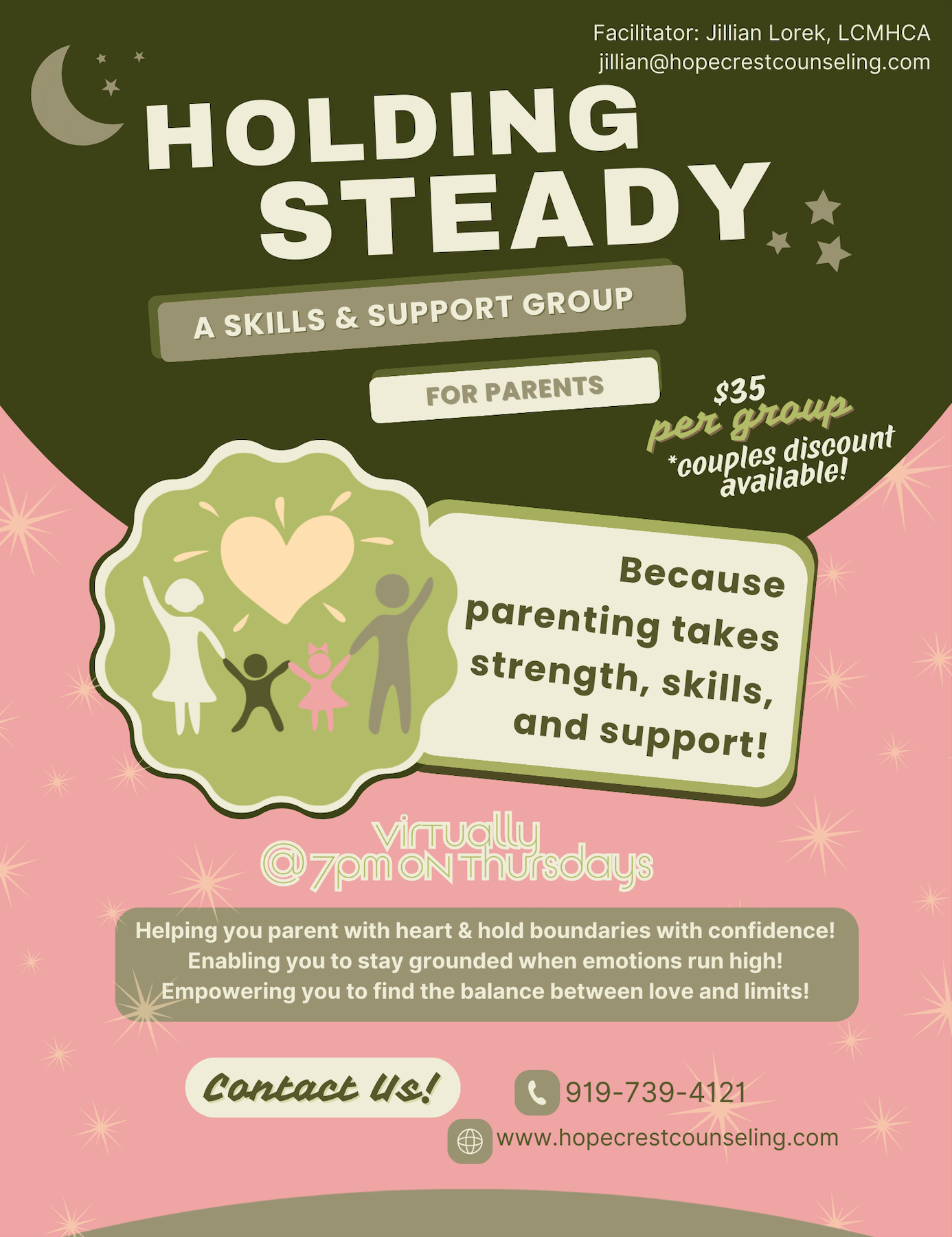
Parenting someone with big emotions can feel overwhelming, exhausting, and sometimes isolating. Holding Steady is an informative AND supportive space for parents who are navigating intense emotions, behavioral challenges, or mental health struggles with their children - of ALL ages!
This group combines practical, research-based parenting strategies with compassionate support from other parents who understand what you're going through. Using DBT-informed skills and emotion-focused parenting approaches, we explore topics such as validation, effective communication, setting healthy boundaries, managing conflict, and responding to emotional crises.
Each session includes guidance from a clinician, real-life examples, and time for discussion so parents can ask questions, share experiences, and learn from one another in a non-judgmental environment.
Our goal is for parents to leave the session feeling more confident, more supported, and better equipped to respond to their child’s emotions without losing themselves in the process.
Group Details:
• Virtual format for convenience and privacy
• Led by a clinician with 26 years of experience working with children and families.
• Designed especially for parents of emotionally intense individuals.
You are not alone in this. Parenting is hard — and support makes a difference.